

📌 The short version
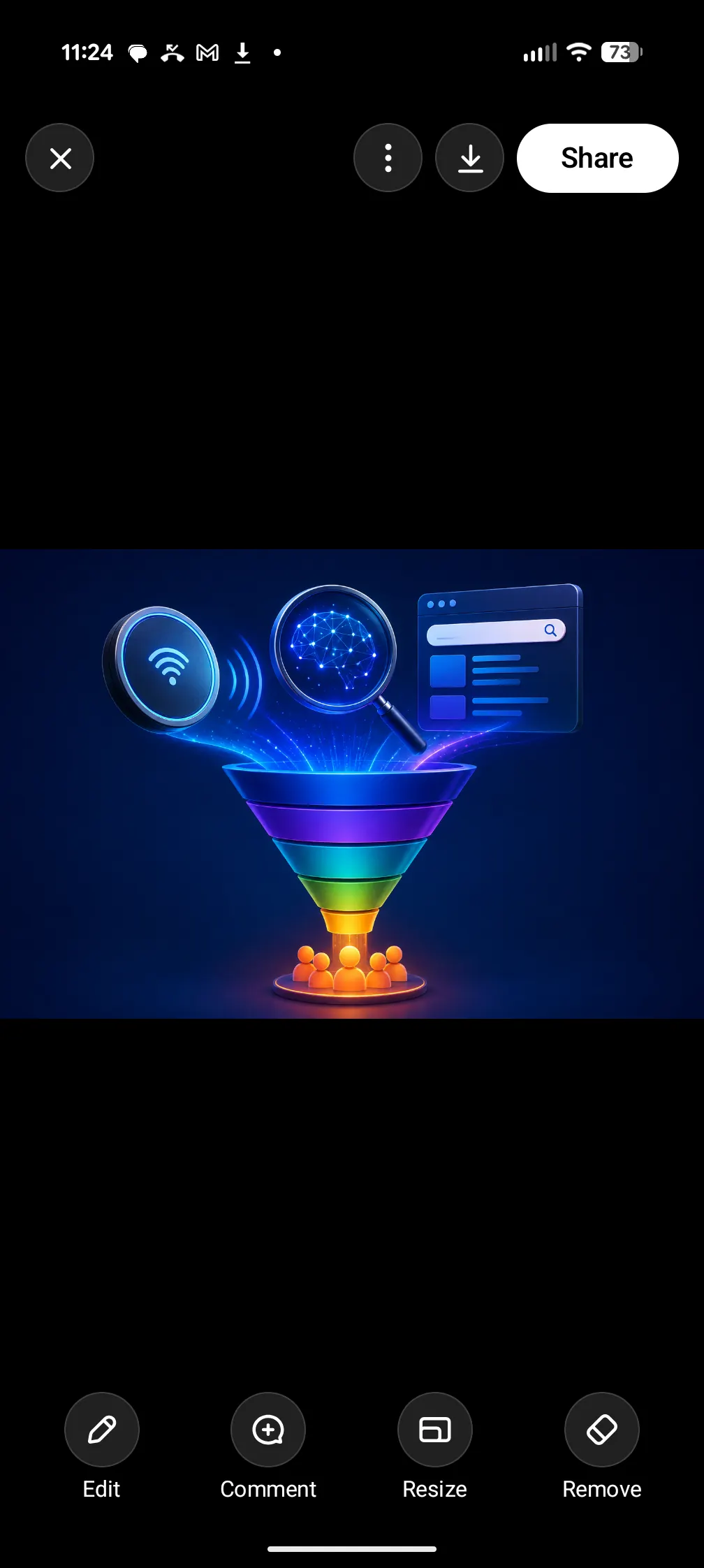
NFC, local SEO and AI search visibility are not three tactics. They are five stages of one loop. A tap at the counter becomes a review. Reviews and profile completeness move your Google Maps position. Map position and entity consistency make you legible to the AI assistants people now ask for recommendations. That recommendation sends a customer who walks in and taps. Each stage feeds the next, which is why the whole thing gets cheaper the longer it runs — and why running the three pieces separately, as almost everyone does, produces three flat line items instead of one compounding system.
Here is a pattern worth noticing. A business buys NFC review cards. They work, sort of. Reviews tick up. Six months later someone asks whether the NFC spend was worth it, nobody can answer, and the cards end up in a drawer.
Meanwhile the same business pays for local SEO, which is also working, sort of. And someone in a meeting asks whether they show up in ChatGPT, which nobody has checked.
Three initiatives. Three budgets. Three separate reports that never reference each other. And the frustrating part is that all three were working — they simply were not connected, so none of them compounded.
Three tactics, no compounding
The reason this happens is structural rather than lazy. NFC gets bought as a print-and-signage decision. Local SEO gets bought as a marketing retainer. AI visibility, if it gets attention at all, arrives as a panic item after someone reads an article about AI Overviews.
Different budgets, different vendors, different vocabularies. So nobody notices that the output of each one is the input of another.
That is the whole insight, and it is not complicated. Reviews are not just social proof — they are a local ranking input. Map position is not just a source of calls — it is one of the signals AI systems consult when assembling a recommendation. And an AI recommendation is not the end of the journey. It sends a human being to a physical place where you can capture them again.
It is not a funnel with a bottom. It is a loop with a flywheel, and the flywheel only spins if you connect the stages on purpose.
The five-stage loop
Here is the whole system on one screen. Read it clockwise, and notice that stage five returns to stage one.
The Tap-to-Rank Loop
Five stages, each one feeding the next
Every stage is a normal marketing activity. The advantage is in the connections, not the components.
Now let's walk each stage, including the part most guides skip entirely — the rules that govern stage two, and the penalties for getting them wrong.
Stage 1 — The tap
NFC is unglamorous technology that has been sitting in everyone's pocket for years. It operates at 13.56 MHz over a range of a few centimetres. A tag contains no battery — the phone powers it briefly through the field it generates, reads the stored link, and offers it as a notification.
Practically, that means no app and no typing. Every iPhone from the XS onward reads tags natively with the screen unlocked. Most Android phones from the last several years do the same. Older iPhone 7 and 8 models need a Control Center toggle, which is the one real gap — so print a small QR code beside the tag as a fallback and stop worrying about it.
Tags are also rewritable. Change the destination and the physical asset keeps working, which matters more than it sounds when a promotion ends or a booking link changes.
Why this beats a QR code at the counter
A QR code asks the customer to open a camera, frame a square and tap a notification. That works fine on a table tent when someone is seated and unhurried. It works badly when a person is standing at a register with roughly thirty seconds of goodwill and a bag in one hand. NFC removes two of the three steps, and completion rate at the moment of intent is the only thing that matters here. Use both where you can — NFC for speed, QR as the fallback.
The eight placements that actually earn their keep
We deploy these across restaurants, home services and professional practices — including the NFC menu network we run for restaurants. Some placements consistently produce, and some are theatre. Here is the honest split.
| Placement | Send it to | Why it works |
|---|---|---|
| Point of sale | Review link | The single best capture moment in any business — the customer is happy, present and holding a phone. |
| Technician leave-behind | Review link | Job just finished, problem just solved. For home services this outperforms every other placement. |
| Reception or counter stand | Review or booking | Captures the wait. Dead time converted into a signal. |
| Table tent or menu | Menu, then review | Update prices without reprinting. The review ask lands at the end of the meal, not the start. |
| Business card | Contact save + site | Saves your details instantly and never goes out of date. Also stops living in a wallet forever. |
| Trade show badge or stand | Lead capture form | Replaces the bowl of business cards with a record that syncs immediately. |
| Window or door decal | Hours, menu, booking | Works when you are closed. Foot traffic at 9pm becomes a booking for Tuesday. |
| Vehicle or equipment | Booking or quote page | Neighborhood visibility while parked at a job. Low volume, but the intent is unusually high. |
One rule governs all of them: one tag, one destination, one job. A tag that opens a menu of choices is a tag that gets abandoned. If you want two outcomes, use two tags.
For the mechanics of programming, testing and placing tags, we covered that in detail in the complete tap-to-connect guide. This article is about what happens after the tap.
Stage 2 — The tap becomes proof
A tap is only worth something if it produces an asset. For most local businesses, the highest-value asset is a review — because unlike a form fill or a follow, a review is independent, public, timestamped and permanent.
Three things decide whether this stage works.
Timing beats persistence
Ask at the moment the customer expresses satisfaction. Not that evening. Not in a follow-up email three days later, when the feeling has faded and the message is competing with forty others.
This is precisely why NFC belongs in this loop rather than email. The tag is physically present at the peak moment, and the gap between "that was great, thank you" and a live review form is about two seconds.
Consistency beats volume
A steady trickle outperforms a burst. Twenty reviews in one week followed by silence looks like a campaign. Two or three a week for a year looks like a business people keep using — and recency is a signal in its own right, because a review from last week says more about your current service than forty from 2023.
Then there are the rules — and most NFC guides never mention them
This is the part worth reading carefully, because the penalties are real and enforcement has already started.
⚠️ FTC Consumer Review Rule — effective October 21, 2024
The FTC's rule on consumer reviews and testimonials (16 CFR Part 465) is now in force. Among other things, it prohibits:
• Offering compensation or incentives conditioned on a review expressing a particular sentiment — whether that condition is stated outright or merely implied
• Fake or AI-generated reviews, and reviews from people who never used the business
• Reviews written by company insiders without clearly disclosing the relationship
• Suppressing or selectively hiding honest negative reviews
Civil penalties currently reach $53,088 per violation. And this is not theoretical any more — on December 22, 2025 the FTC issued its first warning letters under the rule, directing recipients to cease non-compliant practices and confirm remediation in writing.
So where does that leave the "scan for 10% off your next visit" card sitting on a thousand counters?
Squarely on the wrong side of the line, if the discount is tied to leaving a review. Google's own policy prohibits review incentives independently of the FTC, so you are exposed twice over.
✅ What you absolutely can do
Ask every customer for an honest review. Ask in person. Make it effortless with a tag or a direct link. Ask at the best moment. Train your team to ask consistently. Respond to every review you receive, positive and negative.
None of that is restricted. The restriction is narrow and specific: do not attach anything of value to the act of leaving a review, and do not filter who gets asked based on how happy they seem.
That last clause catches people out. Screening customers so that only the delighted ones receive a review request is review gating, and it falls under the suppression provisions. Ask everyone or ask nobody.
If you want the full method — scripts, timing, how to respond to a bad one without making it worse — we wrote that up separately in how to get more Google reviews without being annoying.
Stage 3 — Proof becomes position
Now the reviews start doing a second job.
Google's local ranking rests on three pillars it has described publicly: relevance, distance and prominence. You cannot change distance. Relevance is largely a function of how completely and accurately your profile describes what you do. Prominence is where reviews live.
Practically, four things move local position more than anything else:
- Primary category. The biggest single lever, and the one most businesses get wrong by choosing something too broad. "Contractor" and "Bathroom remodeler" are not the same query surface.
- Review volume, recency and response rate. All three matter independently. Responding is the most neglected — and it is free.
- Profile completeness. Services filled out, hours accurate, photos posted regularly, Q&A populated.
- NAP consistency. Your name, address and phone identical everywhere. Inconsistency actively suppresses ranking rather than merely failing to help.
Notice that the tap loop feeds two of those four directly. Reviews arrive because tags create the moment. And a business in the habit of asking is usually a business in the habit of responding.
The order that trips people up
Fix the profile before you deploy tags, not after. Sending a stream of motivated customers to an incomplete Google Business Profile with the wrong primary category is converting real enthusiasm into a dead end. The destination has to be worth arriving at.
If you want the deeper mechanics of this stage, our local search approach covers profile optimization, citation cleanup and location targeting in full.
Stage 4 — Position becomes citation
This is the stage almost nobody is building for, and it is where the loop stops being a normal marketing tactic.
People increasingly ask an assistant instead of running a search. "Who should I call for a bathroom remodel in Arvada?" produces a short list of named businesses rather than ten blue links. That list is assembled, not ranked — and the assembly process is different from classic SEO in one crucial way.
AI systems weight what others say about you far more heavily than what you say about yourself. Anyone can claim to be the best. Corroboration is the scarce thing.
Which is exactly why stages two and three feed this one. Consider what an assistant has to work with when it evaluates your business:
- Reviews — independent, timestamped, specific, attached to a verified profile. This is the strongest corroboration a local business generates.
- A complete, consistent business profile — hours, category, services, location. Machine-readable and unambiguous.
- Structured data on your site — schema markup that states plainly what you are, where you are, and what you sell.
- Entity consistency — the same details across directories, listings and citations. Conflicting information reduces confidence in citing you at all.
- Specific, verifiable content — "serving Arvada, Wheat Ridge and northwest Denver" is citable. "Serving the metro area" is not.
Every one of those is a byproduct of running stages one through three properly. You do not build AI visibility as a separate project. You build it as the sediment left behind by a working local presence — provided you make the entity legible to machines, which is the part that does need deliberate work.
That deliberate part is what our AI Overview optimization and generative engine optimization work actually consists of: structuring content so it can be quoted, and making the entity unambiguous so it gets quoted as you.
Worth doing right now, before you read further: open two or three AI assistants and ask for a recommendation in your category and city. See whether you appear. If you want a structured version of that exercise, we published a 15-minute self-audit you can run without a tool or an agency.
Want to know where your loop is broken?
We will check your Google Business Profile, your review velocity, and whether AI assistants actually name you when asked. No charge, no obligation, no sales call unless you ask for one.
Stage 5 — Closing the loop
Stage five is the one that turns a funnel into a flywheel, and it is almost embarrassingly simple.
The AI recommendation, or the map pack result, sends a human being. That human being walks into your restaurant, or opens the door for your technician, or stops at your booth. Which puts them within a few centimetres of a tag.
And the loop starts again — except now it is running with more reviews, a better profile and stronger citations than the last time around.
That is the entire argument for building this as a system. A funnel ends at a sale. A loop ends where it started, slightly stronger.
Why loops beat funnels
Here is the maths that makes this worth the coordination effort.
Run the three tactics separately and improvements are additive. Better NFC placement gives you more taps. Better local SEO gives you more calls. They sum.
Run them as a loop and improvements multiply, because each stage's output is the next stage's input. Improve four modest numbers by 10% each and watch what happens:
Four small gains, one compounding result
These are ordinary, achievable improvements. A slightly better placement. A slightly more consistent ask. A more specific category. A few more responses.
1.10 × 1.10 × 1.10 × 1.10 = 1.4641 — roughly 46% more customers from the same foot traffic and the same budget.
Chasing a single 46% jump in any one stage would cost a fortune and probably fail. Four 10% improvements are boring, achievable in a quarter, and mathematically superior. That is the case for the loop in one line.
This is the same reasoning we apply when diagnosing why a business has stalled — find the stage that is genuinely limiting you, fix that one, and let the multiplication do the work. If you are not sure which stage yours is, the free answer desk walks through the diagnostic without asking for anything first.
What breaks the loop
Five failure modes account for nearly every deployment that disappoints. All five are avoidable, and four of them are free to fix.
1. The destination is broken
By far the most common. Tags send motivated people to a half-finished Google Business Profile, or a website that takes six seconds to load on cellular. The capture worked perfectly. The landing did not. Fix the destination before you print anything.
2. Nobody hands them out
A business buys a hundred tags, trains nobody, and finds them in a drawer in March. The hardware is trivially cheap; the habit is the entire cost. Assign it to a person, give them a weekly number, and check it.
3. The ask is incentivized
Covered above, and worth repeating because it is the one that carries a penalty rather than merely wasted effort. Nothing of value may be conditioned on leaving a review. Not a discount, not a raffle entry, not a free coffee.
4. Reviews arrive and nothing happens to them
Responding is free, visible to every future customer, and read by the systems assembling AI recommendations. A business that never replies looks absent. It is the cheapest signal on this entire page and the most commonly skipped.
5. Nobody measures the loop, only the tactics
Taps get reported by whoever sold the tags. Rankings get reported by the SEO vendor. AI visibility gets reported by nobody. So the connections stay invisible, and at renewal each line item looks marginal on its own. Put all four numbers on one sheet and the picture changes entirely.
The 90-day build order
Sequence matters more than speed here, for the same reason it matters in the failure modes above. Build in this order.
Weeks 1–2
Fix the destination first
Complete the Google Business Profile properly. Choose the most specific primary category available — not the broad one. Verify your name, address and phone are byte-identical everywhere online. Test your site on a phone, on cellular, not on office wifi. Nothing else starts until this is done.
Weeks 2–4
Deploy the first three placements
Point of sale, technician leave-behind, counter stand. Three only. One destination per tag, and a distinct tracking URL on each so you can tell which placement actually produces. Resist the urge to deploy all eight at once — you will learn nothing about which ones work.
Weeks 4–8
Build the review habit
Ask at the moment of satisfaction. Ask everyone, not just the visibly happy ones. Never attach an incentive. Respond to every review within a couple of days. Assign it to a named person with a weekly target, because "everyone's job" reliably becomes nobody's.
Weeks 6–10
Make the entity legible to machines
Add LocalBusiness schema. Align every directory listing to match your profile exactly. Publish service and location content with specific, verifiable detail — named neighborhoods, named services, real hours. Give AI systems something concrete to quote instead of marketing prose.
Weeks 10–13
Measure the loop, not the tactics
One sheet, four numbers, reviewed monthly. You will know the loop is live when improving one number visibly lifts the next one four to eight weeks later. That lag is normal — AI systems re-crawl on their own schedule.
What to measure
Four numbers, one sheet, monthly. Anything more elaborate gets abandoned by month three.
| Stage | The number | Where to get it | If it is flat… |
|---|---|---|---|
| Tap | Taps per placement per month | Distinct tracking URL per tag | Placement or staff habit, not the technology |
| Proof | New reviews per month | Google Business Profile | The ask is missing, mistimed, or the destination is broken |
| Position | Map pack rank for your top 3 terms | Manual check from a real local device | Category, completeness or NAP consistency |
| Citation | AI mention rate across 5 fixed prompts | Run the same prompts monthly, log the result | Entity legibility — structured data and corroboration |
That last row is worth explaining, because there is no dashboard for it yet. Write down five prompts a real customer might ask an assistant. Run the same five every month across two or three assistants. Log whether you were named. It is manual and slightly tedious, and it is currently the most honest measurement available.
One honest caveat
This loop assumes you have a physical moment to capture. Retail, hospitality, home services, clinics, trade shows — strong fit. Purely remote businesses have a weaker stage one, though printed proposals, mailed materials and events still create real touchpoints. The other four stages apply regardless. If you have no physical moment at all, build stages two through five and skip the tags rather than forcing a fit.
And the broader point stands well beyond NFC. Most marketing underperforms not because the individual tactics are bad, but because nobody connected them. The businesses that pull ahead are rarely doing something exotic. They are usually doing four ordinary things in an order where each one makes the next one cheaper. That is how we approach engagements as a Denver SEO company — map the loop first, then recommend the tactic.
Questions we get about this
No, and that is the entire advantage over QR codes. Every iPhone from the XS onward reads NFC tags natively with the screen unlocked — no camera, no app. Most Android phones from the last several years behave the same way. The customer holds their phone near the tag and a link appears.
Older iPhone 7 and 8 models read tags through a Control Center toggle rather than automatically, so print a small QR code alongside the tag as a fallback and stop worrying about it.
No. The FTC Consumer Review Rule, effective October 21, 2024, prohibits offering compensation or incentives conditioned on a review expressing a particular sentiment — stated or implied. Google's policy prohibits review incentives independently, so you are exposed twice.
Civil penalties currently reach $53,088 per violation, and the FTC issued its first warning letters under the rule in December 2025. You may ask every customer for an honest review. You may not attach anything of value to it.
QR requires opening a camera, framing the code and tapping a notification, and it degrades in low light or at awkward angles. NFC requires holding the phone near the tag.
The difference shows up in completion rate at the moment of intent — which is the whole game when someone is standing at a counter with about thirty seconds of goodwill. Print both where you can: NFC for speed, QR as the fallback for older devices.
Because AI systems weight third-party corroboration far more heavily than self-description. Anyone can claim to be the best plumber in town on their own website.
Reviews are independent, timestamped, specific and attached to a verified business profile. When an assistant assembles a recommendation it draws on crawlable sources, structured data and what other parties say about you. Recent, detailed, responded-to reviews give it far more to work with than four old ratings and no replies.
Taps and review velocity respond within days. Map pack movement typically appears within 30 to 90 days once the profile is complete and reviews arrive consistently.
AI citation lags furthest — generally four to eight weeks after the underlying signals change, because those systems re-crawl on their own schedule. Expect roughly one full quarter before the stages visibly feed each other. Anyone promising faster is selling.
The tags are inexpensive — typically a few dollars each for stickers and cards — and they are rewritable, so changing a destination costs nothing.
The real cost is the design, the programming, the destination page they point at, and the staff habit of actually using them. A business that buys a hundred tags and trains nobody has bought a hundred stickers. Budget for the process, not the hardware.
Partly. Service-area businesses that visit customers often do better than retail, because a technician leave-behind at job completion is a stronger capture moment than a counter.
Purely remote businesses have a weaker stage one, though trade shows, conferences, printed proposals and mailed materials still create real touchpoints. The other four stages apply regardless of whether you have a storefront.
The destination, always. Sending taps to an incomplete Google Business Profile or a slow site converts real enthusiasm into a dead end and wastes every capture opportunity you create.
Complete the profile, pick the most specific primary category, verify your name, address and phone are identical across the web, and confirm the page loads fast on a phone over cellular. Only then start deploying tags.