

AI SEO Services: Get Cited in Google AI Overviews — Not Just Ranked
Ranking #1 stopped being the ticket. Here is how AI Overviews and AI Mode actually choose their sources — and what it takes to be one.
AI Overviews don't rank ten links. They synthesize an answer and cite a handful of sources — and by March 2026 most of those sources were pages that don't rank in the top ten at all. This is how selection actually works, why AI Mode picks almost entirely different pages than AI Overviews do, and how to read the new Search Console report that finally shows you both.
Free AI Visibility Audit
We'll check whether Google is citing you — and why not, if it isn't.
📞 1-800-481-8638or send details
What a citation is actually worth
There Are Now Three Outcomes on a Results Page
Not two. You are no longer competing to rank or not rank — you are landing in one of three places, and the gap between second and third is roughly a doubling of your clicks.
Organic clicks per 1,000,000 impressions · informational queries
Source: Seer Interactive, April 2026 — a longitudinal study tracking 53 brands, 5.47 million queries and 2.43 billion impressions from January 2025 to February 2026. Cited brands earned about 120% more organic clicks per impression than uncited brands on the same query. Seer's own authors flag the causation caveat: stronger brands may simply be likelier to earn both citations and clicks. We would rather quote that caveat than leave it out.
The floor moved, then partly recovered
Click-through on AI Overview queries bottomed at 1.3% in December 2025 and recovered to 2.4% by February 2026. That is a real rebound, and it still sits well below the 3.3% on searches where no AI Overview appears at all. Treat it as a new floor rather than a return to normal.
Ranking first stopped being the ticket
Only about 17% of AI Overview citations now come from pages ranking in the organic top ten — down from roughly 76% in mid-2024. The average AI Overview draws on more than thirteen sources, up from about seven. Each one is a re-ranked, re-mixed result set pulled from a far wider pool than the page you can see.
The failure mode nobody warns you about: the ghost citation
You can be the source an answer is built from and still get nothing out of it — because the reader never sees your name. Your URL sits in the citation list; the sentence they actually read does not mention you.
61.7%
Of domain appearances were citations with no brand mention in the answer text. On Perplexity the rate reached 52%. Semrush, across 3,981 domain appearances, 115 prompts, 14 countries and four engines.
53.1%
Citation rate when a model named the brand in its answer — against just 10.6% when it did not. Seer, February 2026, across 541,213 responses on six platforms.
What that pair actually means. Being named and being cited move together, and the naming is the half almost nobody works on. It is not earned by keywords — it comes from your business existing as a clear, consistent entity across the web, with the same facts everywhere a machine looks. A meta-analysis of 54 studies found brand mentions correlate roughly three times more strongly with AI visibility than backlinks do. That is a genuine reversal of how SEO has worked for twenty years, and most agencies have not adjusted their playbook for it.
One more finding worth holding onto: cited content runs about 25.7% fresher than the organic top ten across nearly 17 million citations. Publishing once and leaving it is now a visibility decision, not just a content one.
📌 Short answer
You don't rank in an AI Overview — you get cited by one. Overviews and AI Mode are grounded in Google's regular index and draw their links from pages eligible to appear in Search with a snippet. So ranking well makes you eligible; it doesn't make you selected. Selection happens on top of ranking and rewards a different set of things: an answer stated in the opening sentence of its section, coverage of the sub-questions Google fans your topic out into, entity clarity, independent corroboration, and freshness.
What actually changed
For twenty years the search results page was a list. You competed for a position on that list, and position determined clicks.
The results page is now frequently an answer, assembled by a model, with a small set of source links attached to it. Google puts AI Overviews in front of more than two billion people a month, and said at I/O in May 2026 that AI Mode — the conversational surface — had passed a billion monthly users with query volume more than doubling each quarter. Those are Google's own figures rather than independently audited ones, so treat the scale as directional. Gemini 3.5 Flash became the default model behind AI Mode at the same event.
Three things changed materially in 2026, and all three are load-bearing for what you should actually do:
- Ranking stopped predicting citation. Ahrefs found top-ten organic pages supplied 76% of AI Overview citations in July 2025, but only 38% by March 2026 across a dataset of roughly 863,000 keyword SERPs and four million Overview URLs.
- AI Overviews and AI Mode diverged. They share an index and a retrieval mechanic, but they cite almost entirely different pages. More on that immediately below, because it invalidates a lot of published advice — including an earlier version of this page.
- Google finally gave us data. A dedicated generative AI performance report landed in Search Console on 3 June 2026 and finished rolling out worldwide on 31 August 2026. It's incomplete, but it's first-party and it's free.
The distinction that changes the work
An AI Overview is not a featured snippet. A featured snippet lifts one passage from one page — you win it outright or you don't. An Overview synthesizes an answer from several pages and cites a handful of them.
So the goal is no longer to own position zero. It's to be one of the sources the model chose to summarize. That's a lower bar to clear and a harder one to monopolize — several competitors can appear at once, including you.
AI Overviews and AI Mode are not the same surface
Almost every guide published before mid-2026 — including an earlier version of this page — told you these two were effectively one project. Optimize for the Overview, the logic went, and AI Mode comes free, because they run on the same index.
The index part is true. The conclusion isn't.
📌 The number that settles it
Ahrefs compared 540,000 query pairs across both surfaces. AI Overviews and AI Mode reached broadly the same conclusion about 86% of the time — but cited the same URLs only about 14% of the time. Same answer. Almost entirely different sources.
Think about what that means practically. You can be the cited source in an AI Overview for your best commercial query and be completely absent from the AI Mode answer to the same question — while a competitor you've never worried about is the one being described to the customer in a conversation. Neither of you can see the other's position, and until June 2026 neither of you could see your own.
The reason is structural. AI Mode fans a question out much more aggressively than an Overview does, generating more sub-queries and therefore more citation slots, and it runs as a conversation — so follow-up turns like "what does that cost" or "who else does this" are separate retrievals with separate winners. Ahrefs also found the overwhelming majority of AI Mode responses carry at least one citation, so the slots exist; the question is only whose page fills them.
| AI Overviews | AI Mode | |
|---|---|---|
| Where it appears | Above the classic results on an eligible query | A separate conversational surface, and increasingly the default entry point |
| Shape | One answer block, then the blue links | Turn-based dialogue; follow-ups are new queries |
| Index | Same — Google's regular search index, reached by Googlebot. No separate submission for either. | |
| Fan-out breadth | Narrower | Wider — more sub-queries, so more citation slots per answer |
| Citation overlap | Only about 14% of cited URLs are shared, across 540,000 query pairs (Ahrefs) | |
| Extra requirement | None beyond selection | You have to survive the follow-up turns — pricing, alternatives, objections |
| Reported in Search Console | Yes, but blended together as "generative AI features" — impressions only, not split by surface | |
💡 What to do differently
Stop auditing one head query and calling it coverage. Audit the conversation. Ask AI Mode your best commercial question, then ask the three follow-ups a real buyer would ask next — cost, comparison, and "who else". If your page answers the opening question but nothing after it, you are in the answer for one turn and gone for the rest of the decision.
Why your #1 ranking isn't showing up
This is the question we get asked most, usually by someone justifiably annoyed.
The honest answer is that the link between ranking and citation weakened enormously over eight months. In July 2025, per Ahrefs, roughly 76% of AI Overview citations came from pages ranking in the organic top ten. By March 2026 that had fallen to 38%. Which is to say: about six in ten citations now go to pages that don't rank on page one for the query at all.
Position hasn't stopped mattering. The same analysis put a position-one page at roughly a 53% chance of appearing in an Overview, against about 37% for position ten — so ranking still buys you a meaningful advantage. It just no longer buys you the outcome. Ranking gets you into the candidate pool. Something else decides who comes out of it.
Your competitor didn't outwrite you. They just put the answer in the first sentence.
In our audits the single most common reason a first-position page gets skipped is structural, not editorial. The page answers the question well — on the third paragraph, after a warm-up. There's no clean passage to lift, so the model lifts one from somewhere else.
The second most common reason is topical thinness. A single strong page on a weakly connected domain gets cited less often than a mid-strength page sitting inside a well-developed topic hub. Google is assessing whether your site is a credible source on this subject, not whether one URL is well optimized.
There's a third reason worth naming because you cannot fix it and should stop trying: domain diversity limits. A Google patent published in March 2026 describes building separate passage sets for the main query and each related query, then capping how many passages any single domain or single page can contribute to the final answer. The example limits in the patent are one or two passages per domain. Those are illustrative numbers rather than published rules, but the principle is explicit — the system is designed so one site does not supply the whole answer. Which is good news if you're the challenger and irritating if you're the incumbent.
Query fan-out: the mechanic worth understanding
When you ask Google a question, it no longer just matches your keywords. It decomposes the question into sub-queries, runs them in parallel, and assembles an answer from what comes back. That's query fan-out.
It sounds like an implementation detail. It isn't — it changes the unit of optimization from the page to the passage.
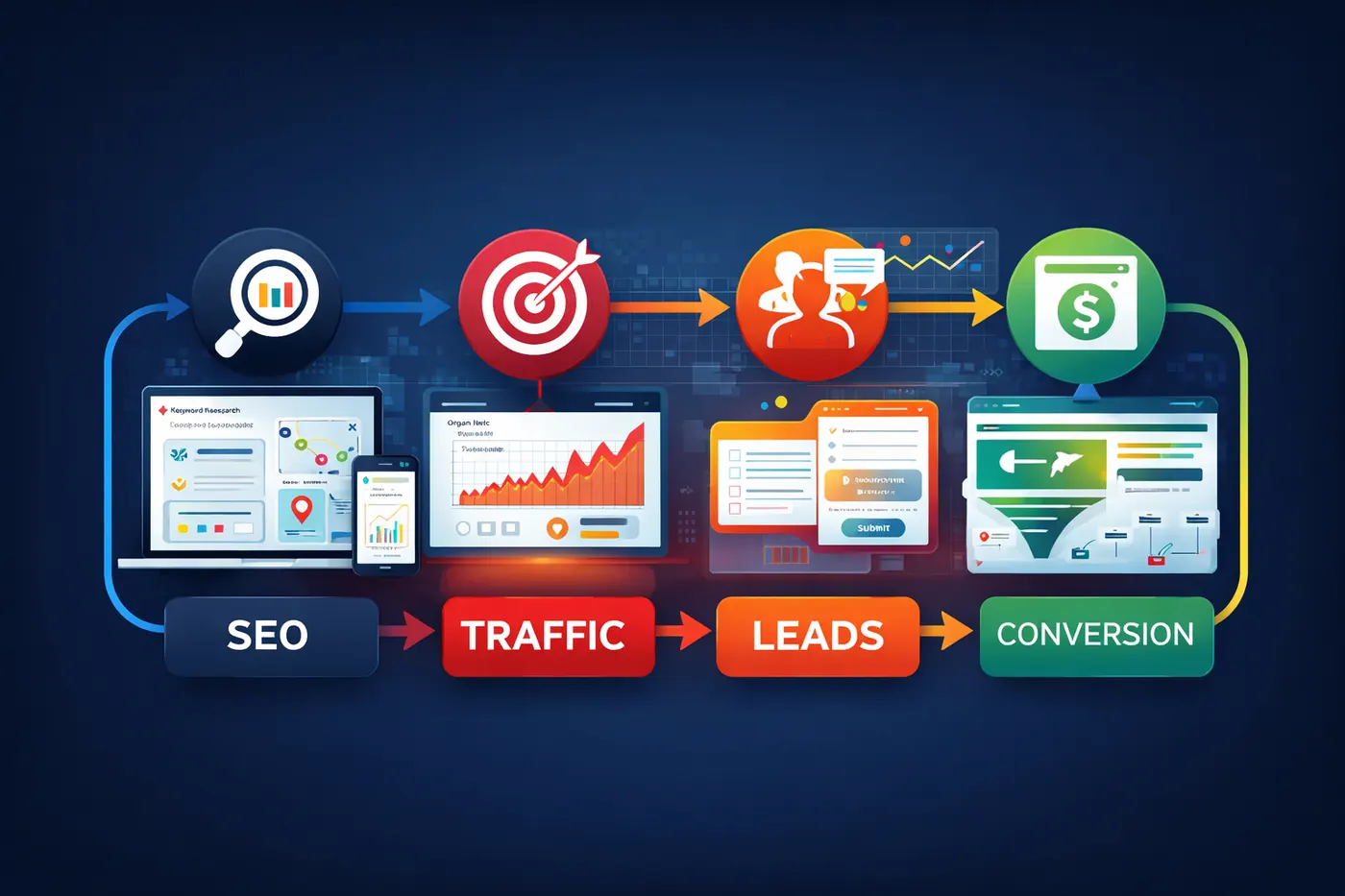
You are no longer competing for a keyword. You are competing to be the best available answer to each sub-question your topic breaks into. Fan-out analysis published in 2026 found pages that rank for the hidden sub-queries are dramatically more likely to be cited than pages ranking only for the visible head term — one widely-referenced figure puts the gap at roughly 160%. Treat the magnitude as directional; the direction itself is not in dispute.
That's why thorough pages with clearly headed sections outperform tightly optimized short ones, and why "we already have a page targeting that keyword" is no longer a complete answer to whether you're covered.
It also explains an effect people find counterintuitive: you can get cited for questions you never targeted. If your page happens to answer a sub-query cleanly, it becomes a candidate — regardless of what the page was written to rank for.
How to find your own fan-out without buying a tool
You don't need software for the first pass. Take your highest-value commercial query and write down the ten questions a buyer asks around it — cost, comparison, alternatives, timeline, risk, objections, definitions, examples, "is it worth it", "what goes wrong". Google's People Also Ask and autocomplete will fill gaps for free. So will your inbox and your phone log, which are better sources than either because they're the questions people actually ask you.
Then audit honestly: does each of those questions have its own clearly headed section somewhere on your site, with the answer in the first sentence underneath it? The ones that don't are your fan-out losses. That list is usually the entire content plan for the next quarter.
Question-shaped queries trigger Overviews far more often
Queries phrased as questions or how-tos are substantially more likely to display an AI Overview than short generic terms, and longer conversational queries trigger them more than brief ones. That gives you something concrete to do this week: go through your service pages and find every place a customer would have asked a question that you answered as a statement. Those are your openings.
The six factors that decide whether you get cited
In rough order of how often they're the blocker.
Index and snippet eligibility
The gate nothing gets past
AI Overviews and AI Mode surface links from pages eligible to appear in Search with a snippet. A page that isn't indexed, is blocked from snippets by a nosnippet or max-snippet directive, or sits behind a crawler block cannot be cited — regardless of quality.
New in 2026: Search Console now carries a control that blocks your content from appearing in AI features entirely. It's a legitimate choice for some publishers. It is not a choice you want to have made by accident.
Check first: is the page indexed, crawlable, snippet-eligible, and not opted out of AI features? A surprising number of "why aren't we cited" cases end right here.Answer-first passage structure
The most common fixable failure
The answer to each sub-question belongs in the opening sentence of its section. Not paragraph three, not after the context-setting. Retrieval happens at passage level, so if a reader who only read your first sentence wouldn't have the answer, there's nothing clean to extract.
Do this: use H2s and H3s that mirror the question wording — how, what, why, vs, best, cost — then answer immediately underneath in one sentence, and expand after.Sub-question coverage
Depth beats keyword targeting
Because of fan-out, breadth within a topic is what multiplies your chances. A page covering one question has one shot at citation. A page covering the eight questions a buyer genuinely asks has eight — and in AI Mode, where the fan-out is wider still, more than that.
Do this: list every question a customer asks before buying, then check each has its own clearly headed section somewhere on your site.Entity clarity and structured data
Can Google tell who you are?
Before deciding whether to trust a source, Google has to resolve what that source is. Consistent business information, correct schema markup and unambiguous identity signals all feed that. Conflicting details across the web actively work against you — and this is where most local businesses quietly lose, because their hours, services and address disagree across four platforms.
Read more: our guide to entity signals covers the five layers and includes a free scorecard.Third-party corroboration
Independent verification of your claims
Anything you say about yourself is weighted below what others say about you. Earned mentions, genuine reviews and independent references are what let a model treat a claim as verified rather than asserted — and topical authority accrues to the domain, not the URL.
This matters more in local than most people realise. Whitespark's study of local AI Overviews found roughly 60% of cited sources were third-party publishers rather than the businesses being discussed. If the answer is built from directories and roundups, being absent from those is a citation problem no amount of on-site work fixes.
Do this: audit whether your central claims are corroborated anywhere other than your own site — then audit which third parties are being cited for your money queries, and get into those.Freshness
The one that silently reverses
Freshness is a live selection factor, which means citations decay. Content that earned a citation can lose it purely by aging while a competitor updates. This is the factor most often overlooked, because nothing visibly breaks — you simply stop appearing, and no report tells you why.
Do this: schedule reviews of your highest-value pages rather than treating publication as completion. Put a real reviewed-on date on the page and honour it.⚠️ What doesn't work
There is no schema type that makes Google cite you, no keyword density target, and no way to buy your way into an Overview. Anyone selling "guaranteed AI Overview placement" is selling something that does not exist — and given the domain-diversity limits described in Google's own patent, guaranteed dominance is doubly impossible. The work is unglamorous: be eligible, be structured, be corroborated, be current.
Will your query trigger an AI Overview?
Type a search the way a customer would actually phrase it. This scores the query against the patterns that trigger Overviews most reliably — question form, length, intent type, comparison structure, and the local-intent split that most rank trackers never check.
Free · Nothing to fill in
AI Overview trigger checker
Runs in your browser. No signup, no email, nothing stored or sent anywhere.
Phrase it the way a customer would say it out loud, not the way you'd write a keyword.
This is a heuristic based on published trigger-rate patterns, not a live lookup against Google. Treat it as a guide to how to phrase content, not as a prediction of a specific result.
AI Overview vs AI Mode vs featured snippet vs blue link
These four get used interchangeably and they behave completely differently. Optimizing for one does not automatically win the others.
| Blue link | Featured snippet | AI Overview | AI Mode | |
|---|---|---|---|---|
| Sources shown | Ten, ranked | One | Several, cited beside a synthesized answer | A small, selective set per turn |
| You win by | Ranking higher | Owning the passage outright | Being selected as one of the sources | Being selected, then surviving the follow-ups |
| Unit optimized | The page | The passage | The passage, per sub-question | The passage, across a wider fan-out |
| Competitors co-appear? | Yes, below you | No | Yes, beside you | Yes, and they change between turns |
| Main lever | Relevance and authority | Format and directness | Eligibility, structure, corroboration, freshness | Everything left of this, plus conversational depth |
| Fails because | Weak authority | Answer isn't clean enough | Answer is buried, or the topic hub is thin | You answered turn one and nothing after it |
| Visible in Search Console | Yes — clicks, impressions, position | Yes, within Web | Impressions only, blended, since May 2026 | |
💡 The practical upshot
Because several sources appear in one Overview, you don't have to beat your biggest competitor to appear next to them. For a local business competing against national directories, that's a meaningfully different proposition than trying to outrank them — and the domain-diversity limits in Google's retrieval patent mean the directory can't take every slot even when it deserves to.
The one AI visibility lever your audience pulls for you
Every other signal on this page is something a model decides about you. Preferred Sources is the exception, and it's the least-known lever in AI search right now.
Free · Takes about thirty seconds
Google Preferred Sources, now inside AI answers
Preferred Sources is a Google Search setting where a reader nominates the sites they want to see more of. It launched for Top Stories in 2025. On 27 May 2026 Google extended it into AI Overviews and AI Mode — so when a reader who has chosen you sees an AI answer that cites your page, that link carries a visible label instead of blending into five anonymous sources.
Google's own reporting is that people are about twice as likely to click a source they've preferred, and that more than 600,000 unique sources have been selected since the AI rollout, up from roughly 345,000 at launch. Treat the 2x as directional — it's Google's number, not an independent one.
The part that matters for a service business: any site that publishes fresh content is eligible. There's no application, no threshold, no ranking factor to earn. Since 20 August 2026 there's also been an embeddable one-click button you can put on your own pages instead of sending people into a settings menu.
Two honest caveats, because this gets oversold the moment anyone discovers it. Preferred Sources personalises what one opted-in reader sees — it doesn't lift you in everyone else's results, and it isn't a substitute for being citable in the first place. And it rewards businesses that actually publish. If your last post was in 2023, this lever does nothing for you and the honest fix is further up this page.
But for a business with a real audience and a live blog, it's free, it takes a sentence in your next newsletter, and it's the only part of AI visibility where asking politely works.
How to get cited: the sequence
Order matters. Steps two and three do nothing if step one isn't done. The six steps below mirror the HowTo markup in this page's structured data — edit one, edit the other in the same commit.
Step 1
Earn index and snippet eligibility first
Both surfaces are grounded in the regular index and pull links from pages eligible to appear in Search with a snippet. Confirm indexation, crawler access and snippet eligibility before touching anything else.
Then check the newer trap: Search Console now has a control that blocks your content from AI features. If you're blocking AI crawlers in robots.txt while hoping to appear in AI answers, resolve that contradiction deliberately rather than by accident.
Step 2
Map the query fan-out
Write down the sub-questions your main topic decomposes into — cost, comparison, alternatives, objections, definitions, examples, what goes wrong. People Also Ask and autocomplete are free sources; so are your inbox and your phone log. Then check each has a home on your site.
Step 3
Put the answer in the first sentence
Restructure so each section leads with its answer. Headings mirror the question wording. Add a table where the query implies comparison and a step list where it implies sequence — both are extracted more readily than prose.
Test each section by asking: if someone read only the first sentence, would they have the answer?
Step 4
Build entity clarity and third-party corroboration
Consistent business data, correct schema, independent mentions. A mid-strength page inside a well-connected topic hub gets cited more than a strong page on a thin domain — so this is domain-level work, not page-level.
In local especially, find out which third-party sources are being cited for your money queries and work on being present in those, because that's frequently where the answer is actually being assembled from.
Step 5
Set up measurement before you judge results
Open the generative AI performance report in Search Console — detailed in the next section — and take a baseline in the first thirty days. Pair it with a fixed panel of real buyer prompts checked on a schedule, and with call and form tracking on your own site, because impressions are not leads.
Step 6
Keep it fresh, then ask readers to prefer you
Schedule content reviews. Citations decay quietly as pages age — nothing breaks, you simply stop appearing. Then ask your existing audience to add you as a Preferred Source, which is the cheapest visibility work on this entire page and the only part where asking politely is the whole strategy.
How to actually see your AI citations — the 2026 method
Most agencies still report on this with screenshots. There's a first-party source now, and it's new enough that a lot of published advice — including the previous version of this page — points at the wrong place.
📌 Where to look
Search Console → Performance → the generative AI performance report. Google announced it on 3 June 2026 and finished rolling it out to all websites worldwide on 31 August 2026, so it should be in your property now. It isolates impressions inside generative AI features on Search — AI Overviews and AI Mode together — broken down by page, country, device and date. Data starts in May 2026; there is no earlier history.
Older instructions that send you to a "Search Appearance → AI Overview" filter are out of date. That's not where the data lives.
What the report gives you, and what it deliberately doesn't
Read this part carefully, because the gap between what it measures and what people assume it measures is where bad decisions come from.
| You get | You don't get |
|---|---|
| Impressions inside AI Overviews and AI Mode | Clicks, as a separate AI metric |
| Breakdown by page | Click-through rate |
| Breakdown by country and device | The query or prompt that produced the appearance |
| A date series, from May 2026 onward | Average position |
| A separate view for Discover | A split between AI Overviews and AI Mode |
| First-party data, free, in a tool you already have | Anything at all about ChatGPT, Perplexity, Gemini or Claude |
A few consequences worth stating plainly:
- An impression is exposure, not a visit. Ten thousand AI impressions is not ten thousand visitors, and it is not ten thousand of anything you can bank. It is upper-funnel visibility. Leads and revenue still get judged in your analytics and your phone log.
- Clicks aren't missing, they're blended. Clicks on links inside AI answers are still counted in the overall Web totals in the standard performance report. They're just not broken out, which means you cannot cleanly attribute a lead to an AI citation. Anyone showing you an "AI conversion rate" from Search Console is showing you a number the tool does not produce.
- The two surfaces are blended too. Given that AI Overviews and AI Mode overlap on only around 14% of cited URLs, a single combined impression figure is coarser than it looks. It tells you that you're visible in generative AI. It doesn't tell you where.
- No history before May 2026. So "are we better than last year" is a question this report structurally cannot answer yet. Set a baseline now; the comparison becomes possible later.
The diagnostic that still works
The old click-through diagnostic hasn't stopped being useful, and it's the fastest way to spot an Overview eating a query: look for a sharp click-through-rate drop on informational queries where your average position stayed flat. Position unchanged, clicks down, means something appeared above you. Now you can cross-check that against the impression data instead of guessing.
✅ What we track for clients
The Search Console generative AI report for first-party impressions, plus a fixed panel of real buyer questions run against both AI Overviews and AI Mode on a schedule — the same prompts, same intervals, so movement is comparable rather than anecdotal. Because the two surfaces cite different pages, we run them separately rather than assuming one stands in for the other.
That's paired with call tracking and form attribution on your own site, so we can say something honest about whether visibility turned into revenue instead of hoping the impression chart speaks for itself. Reported against the baseline set in the first thirty days.
The thing most owners find surprising when they first see the data: Overviews are triggering on far more of their priority queries than they assumed, and they hold far less of that surface than they assumed.
Do AI Overviews cost you traffic?
Honestly, for some queries — yes, and there's now causal evidence rather than correlation. A randomized field experiment by Agarwal and Sen, circulated in 2026, found AI Overviews cut organic clicks by around 40% on affected queries, with the share of searches ending in no click at all rising from roughly 54% to 72% when an Overview appeared. Sponsored clicks were essentially untouched.
Purely informational questions take the worst of it, because the user's need is met on the results page. Commercial queries are more mixed. An Overview often appears alongside a perfectly healthy set of results, and the traffic that does reach a cited page tends to be higher intent — that visitor read a summary and clicked anyway.
There's a related finding worth knowing if you run a phone-driven business: Invoca's 2026 analysis of inbound calls found calls referred from AI assistants produced a qualified lead at a slightly higher rate than calls from a Google Business Profile. Fewer clicks, better clicks. That's not a consolation prize — it's a reason to make sure the phone is answered well, which we'll come back to.
Either way the strategic response is the same, and it isn't waiting: be the cited source.
Why local businesses have the easier path — and the trap inside it
Most writing on this subject is aimed at national publishers competing on informational topics against sites with enormous authority. That's a brutal fight.
It is also not your fight. We work this problem every day in a competitive local market of our own, and the local version of it is meaningfully easier than the national one — for a reason worth understanding.
Local commercial queries are a different market. "Best HVAC company in Denver" has a far smaller pool of genuinely relevant sources than "how does a heat pump work". The competition is thinner, and the signals that matter are ones a small business can actually build.
But there's a trap in the local data that almost every rank tracker walks straight past, and it costs businesses months of misdiagnosis.
📌 The local intent split
Phrasing decides everything. Whitespark's 540-query study across three cities and six industries found AI Overviews on about 68% of local business queries versus local packs on about 39%. But split by intent, the picture inverts: plain "near me" style searches triggered an Overview only around 15% of the time, while informational-local questions triggered one roughly 77% of the time.
Read that again if you run a service business, because it's the whole diagnosis. "Emergency plumber near me" still returns a map pack. Your customer in that moment is not reading an AI summary; they're tapping the second listing. If that's most of your revenue, the panic headlines about AI killing local search do not describe your situation.
What is being eaten is the layer above it — "how much does a water heater replacement cost", "do I need a permit to replace a furnace in Colorado", "how do I choose a roofing contractor". That's your guide content, your blog, the material that used to bring people into your world weeks before they were ready to call. That traffic is falling whether or not your map pack position moved, which is exactly why owners tell us rankings look fine and the phone got quieter.
The second trap is who gets cited. In those local Overviews, Whitespark found roughly 60% of cited sources were third-party publishers — directories, roundups, local press — rather than the businesses themselves. Your Google Business Profile is not a citation. It's an input to the map pack, and the map pack is a different mechanism.
That shows up in the ranking-factor weights too. The 2026 Local Search Ranking Factors survey — 47 specialists scoring 187 factors — put Google Business Profile signals at roughly 32% of traditional local pack weight, the single heaviest category, with reviews around 20% and on-page around 15%. For AI search visibility the order flips: on-page moves to the top slot at roughly 24% and GBP signals fall to about 12%. Same business, same market, two different formulas.
68% / 39%
AI Overviews vs local packs on local business queriesWhitespark, 540-query study
15% / 77%
Overview trigger rate on plain "near me" vs informational-local questionsWhitespark
~14%
URL overlap between AI Overviews and AI Mode citationsAhrefs, 540,000 query pairs
38%
Share of Overview citations from top-ten pages by March 2026, down from 76%Ahrefs
~60%
Local Overview citations going to third-party publishers, not the businessesWhitespark
4–8 wks
Typical lag between signal changes and citation changesOur own client observation
There's one more number that reframes the whole thing. BrightLocal found the share of consumers using AI for local recommendations rose from around 6% in 2025 to roughly 45% in 2026. Whatever you think of AI answers, close to half your market is now asking one before they call anybody.
What actually moves the needle locally
A genuinely complete Google Business Profile, business details that agree with themselves everywhere they appear, real reviews, and content that names actual neighborhoods and service areas rather than repeating the metro name. Then, separately, presence in the third-party sources your local Overviews are already citing — because that's where the answer is being built.
The profile and map-pack half of that is its own discipline, and we cover it properly on our Google Business Profile and map pack page. This page is about the layer sitting on top of it.
And a caveat we'd rather say than have you discover in four months: none of this replaces the fundamentals. If your site isn't indexed properly, your profile is half-finished and your service pages are thin, then AI citation is not your problem yet. Get the basics working first — the search fundamentals and your local visibility — then come back to this page — it'll still be here, and it'll be worth more to you.
Competitive density also varies enormously between adjacent Denver suburbs, which is why we build separate strategies rather than one metro-wide campaign:
Where this sits in the wider picture
This page covers Google's own AI surfaces — AI Overviews and AI Mode — which run on Google's search index. ChatGPT, Perplexity and cross-engine brand presence are a related but distinct problem, covered on our page about earning citations from other AI engines.
Most of the foundation serves both, which is why we run them as one engine rather than two programs. The commercial side — scope, what a monthly engagement includes and how it's reported — is on the ongoing SEO services page, and typical investment ranges are set out in our pricing guide.
What happens when the AI stops summarizing and starts dialing
Citation is the current problem. It is not the last one.
The businesses that will handle that shift comfortably are the ones already set up to answer a question the moment it is asked, whoever — or whatever — is asking. That is part of what an assistant on your own site is for.
At Google I/O on 19 May 2026, Google announced it was expanding agentic booking in Search to local experiences and services — and that for selected categories, home repair, beauty and pet care, a user can ask Google to call businesses on their behalf. The US rollout was scheduled for summer 2026.
Strip away the novelty and the mechanic is simple. A customer describes a job. An agent contacts the businesses that plausibly do that job, asks the practical questions the customer typed — do you cover this area, what does it cost, when can you come — and returns a written comparison of who answered and what they said.
Here's the detail almost nobody quotes, and it's the useful one. Google's own help documentation describes booking through an online booking partner first, and placing an automated call second. The phone call isn't the feature. It's the fallback for businesses whose availability and pricing exist only in someone's head or on a whiteboard behind the counter. Every agentic call is a small tax paid because there was no machine-readable endpoint to check.
💡 The three cheap fixes
1. Make your availability and pricing readable by a machine — real-time booking where your category supports it, Service and Offer markup where it doesn't, and prices that are actually stated rather than "call for a quote".
2. Make your Business Profile services granular. An agent maps a homeowner's phrasing to your service list. "Plumbing" doesn't match "water heater replacement" as well as "water heater replacement" does.
3. Answer the phone properly. A human caller who reaches voicemail usually tries again — they already chose you. An agent running a live comparison does not try again. It dials the next business and you never learn the booking existed.
If you're in one of the named categories, this is nearer than it sounds — home service contractors and HVAC companies sit squarely inside "home repair". And the third fix is the one most businesses fail and the cheapest to fix, which is a sentence we end up writing more often than any other.
Score your own page in two minutes
Ten checks, drawn from everything above. Pick one page you actually care about — a service page or your best guide — and answer honestly. Nothing is stored and nothing is sent anywhere.
Free · No email · Nothing stored
AI citation readiness check
Tick everything that's already true of the page you have in mind.
0 of 10
Tick the boxes above and this updates as you go.
If you scored well, genuinely — go do something else, and come back when Google changes the rules again. We'd rather be useful than urgent.
AI search terms, defined plainly
These are the terms that come up in every conversation about this, usually undefined. The definitions below are mirrored in this page's structured data so both people and machines read the same thing.
AI Overview
A generative answer at the top of Google's results, synthesized from several pages and shown with a small set of cited source links.
AI Mode
Google's conversational search surface. Same index as Search, but it selects its citations separately from AI Overviews — the two overlap on only about 14% of URLs.
Query fan-out
Google splitting one question into multiple sub-queries, running them in parallel, and assembling an answer from the best passage for each.
Passage-level retrieval
Selecting and citing a specific passage within a page rather than the page as a whole. It's why the passage, not the page, is now the unit of optimization.
Grounding
Tying a generated answer to real retrieved documents so it can be attributed to sources, rather than produced from model memory alone.
Preferred Sources
A Google setting where readers nominate sites they want surfaced more often. Since May 2026 those picks are labeled inside AI Overviews and AI Mode.
Information gain
How much a page adds that isn't already in the sources an engine has. A new fact beats a better restatement of an existing one.
Zero-click search
A search that ends without visiting any website, because the results page answered it. Rises from roughly 54% to 72% when an AI Overview appears.
AI Overview optimization — common questions
The fourteen we get asked most, answered the way we'd answer them on the phone.
You don't rank in an AI Overview — you get cited by one, and the distinction changes the work. Overviews are grounded in Google's regular index and pull supporting links from pages eligible to appear in Search with a snippet.
The sequence: earn index and snippet eligibility first, write answer-first passages that extract cleanly, cover the sub-questions Google fans your topic out into, build entity clarity and independent corroboration, keep content fresh, then measure which queries produce an appearance using the Search Console generative AI report.
Because ranking and citation are decided differently, and the gap between them widened sharply through 2026. Ahrefs found top-ten organic pages supplied 76% of AI Overview citations in July 2025 but only 38% by March 2026 — meaning most citations now come from pages outside the top ten.
Position still helps: the same analysis put position one at roughly a 53% chance of appearing versus about 37% for position ten. But it's no longer decisive. In our audits the most common reason a #1 page gets skipped is structural — the answer is buried several paragraphs down rather than stated in the opening sentence, so there's no clean passage to extract.
No, and treating them as one surface is a common and expensive mistake. They share the same index and the same query fan-out mechanic, so the foundation work serves both. The output does not follow.
Ahrefs compared 540,000 query pairs and found AI Overviews and AI Mode cite the same URLs only about 14% of the time, even though they reach broadly the same conclusion around 86% of the time. Same conclusion, almost entirely different sources. That means being cited in an AI Overview is weak evidence that you appear in AI Mode, and the two have to be measured separately.
A featured snippet lifts one passage from one page. An AI Overview synthesizes an answer from several pages and shows a small set of source links alongside it.
That changes the goal completely: you're not trying to own position zero outright, you're trying to be one of the handful of sources the model chose to summarize. It also means several competitors can appear at once — which makes an Overview easier to break into and much harder to dominate.
Query fan-out is Google breaking a single question into multiple sub-queries, running them in parallel, and assembling the answer from what comes back. It matters because it changes the unit of optimization from the page to the passage.
You're competing to be the best answer to each sub-question your topic decomposes into. Published fan-out analysis in 2026 found pages that rank for the hidden sub-queries are substantially more likely to be cited than pages ranking only for the visible head term. A page that answers eight sub-questions in eight clearly headed sections has eight chances to be cited rather than one.
Google launched a dedicated generative AI performance report in Search Console on 3 June 2026 and finished rolling it out to all websites worldwide on 31 August 2026. It sits under Performance and isolates impressions inside generative AI features on Search, covering AI Overviews and AI Mode, with breakdowns by page, country, device and date.
Data begins in May 2026, so there's no earlier history to compare against. Older guidance pointing at a Search Appearance filter is out of date.
Because the dedicated generative AI report launched as a visibility report rather than a performance report. At launch it provides impressions, pages, countries, devices and dates, and does not separately provide clicks, click-through rate, queries or average position.
Clicks on links inside AI Overviews and AI Mode are still counted inside the overall Web totals in the standard performance report; they simply aren't broken out. The practical consequence is that an AI impression proves exposure, not a visit — so read it alongside your own call tracking, form tracking and analytics rather than treating it as a business result on its own.
For some query types, measurably yes. A randomized field experiment published in 2026 by Agarwal and Sen found AI Overviews caused organic clicks to fall by around 40% on affected queries, with the share of searches ending without any click rising from roughly 54% to 72%.
Purely informational questions take the worst of it because the user's need is met on the results page. Commercial queries are more mixed: an Overview often appears alongside a healthy set of results, and traffic that does reach a cited page tends to be higher intent, because the visitor read a summary and clicked anyway. The strategic response is to be the cited source rather than to hope Overviews go away.
Yes, and local queries are frequently the easier win. National informational topics are contested by publishers with enormous authority, while a query like "best HVAC company in Denver" has a far smaller pool of genuinely relevant sources.
The catch is that local AI Overviews often cite third-party publishers rather than the businesses themselves — Whitespark's study of local AI Overviews found roughly 60% of cited sources were third parties. So the work isn't only optimizing your own site but earning presence in the directories, roundups and local publications the answer is likely to be built from.
They sit above it rather than replacing it, and the effect depends entirely on how the query is phrased. Whitespark's 540-query study found AI Overviews on about 68% of local business queries against local packs on about 39% — but on plain "near me" style searches Overviews appeared only around 15% of the time, while informational-local questions triggered them roughly 77% of the time.
So a plumber ranking well for "emergency plumber near me" is largely unaffected, while the same plumber's guide content is being summarized above the fold. Separately, Sterling Sky found AI-generated local packs surface far fewer distinct businesses than traditional three-packs across the same query set, which concentrates visibility among fewer providers. Our local search page covers the map-pack side in full.
Preferred Sources is a Google Search setting where a reader nominates the sites they want to see more of. On 27 May 2026 Google extended it into AI Overviews and AI Mode, so a chosen source now gets a visible label when it's cited inside an AI answer, and Google says readers are about twice as likely to click a source they've preferred.
Any site that publishes fresh content is eligible, there's no application or ranking factor to earn, and since 20 August 2026 there's been an embeddable one-click button you can put on your own pages. It's the rare AI visibility lever that your audience pulls rather than an algorithm, which makes it unusually worth asking for.
Scannable structure beats long uninterrupted prose. Short definitional openers, headings that mirror the question wording, comparison tables where the query implies a comparison, and step lists where it implies a sequence all appear disproportionately.
Question-shaped queries are also substantially more likely to trigger an Overview in the first place, so content organized around real buyer questions has an advantage before extraction even begins. Information gain matters too: a page that adds a fact, a figure or a first-hand observation the other sources lack gives the model a reason to include it rather than a fifth restatement of the same ground.
For a site already ranking in the top ten with solid trust signals, structural changes can show up within weeks. For a site that doesn't yet rank, the honest answer is longer — index eligibility and organic visibility come first, and those take months.
AI citation also lags the underlying signal change by roughly four to eight weeks, since these systems recrawl and reassess on their own schedule rather than yours. Anyone promising guaranteed AI Overview placement on a timeline is selling something that doesn't exist.
They overlap but aren't the same. This page covers Google's own AI surfaces — AI Overviews and AI Mode — which are grounded in Google's search index.
Generative engine optimization deals with how ChatGPT, Perplexity, Gemini and Claude perceive and represent your brand across the whole web, which depends far more on third-party mentions than on your own site. Most of the foundation work serves both, which is why we run them together rather than as separate programs.
On the figures above. Citation-share and surface-overlap data is from Ahrefs' 2026 analyzes. Local intent and citation-source splits are from Whitespark's 540-query study across three cities and six industries, and its 2026 Local Search Ranking Factors survey of 47 specialists scoring 187 factors. AI local pack inventory comparisons are from Sterling Sky. Click-loss figures are from the Agarwal and Sen randomized field experiment circulated in 2026. Search Console reporting, Preferred Sources, agentic booking and model details come from Google's own announcements and documentation. Consumer AI adoption for local recommendations is from BrightLocal. Call-quality figures are from Invoca. Percentages vary by methodology, category and device — treat them as direction, not precision. Reviewed and verified .
Find out whether Google is citing you — or your competitor
A free AI visibility audit: which of your buyer questions trigger AI Overviews, who's being cited for them today, what AI Mode says when the conversation continues, and what's structurally blocking you. You get the findings whether or not you ever hire us.
The audit carries no contract and no obligation. Denver-based since 2012 · A+ BBB Accredited · 5.0 from 60 Google reviews
Where to go next
The engineering behind AI search optimization, from schema to crawl budget to JavaScript rendering, lives on our technical property: AI SEO programming at DenverSEO.io covers the code-level work this system is built on. For Google Business Profiles, which AI answers lean on heavily for local queries, see Google Business Profile management.
Assets that accelerate the work on this page
Clients get put through properties we built: press release distribution — a platform that pushes a release to every channel open to a small business, with a public record of where it landed — plus press release for business through pressreleaseforbusiness.com and a business directory at usabusinesssearch.com. It is one reason the same budget goes further here. We don't need to knock anyone else's work; we'd rather show you ours. What you get, on a sliding scale →