

SEO Services for Small Business That Work as One System, Not Five Line Items
Monthly SEO services, priced so a small business can actually start — and scoped so you know exactly what you are buying.
Most SEO retainers are five disconnected activities billed together. A system sequences them so each layer makes the next one cheaper — and runs search and AI visibility on one engine instead of two. Here is exactly what that includes, what it costs, and the questions to ask before you hire anyone.
Get a Free SEO Audit
We'll show you what's working, what isn't, and what it would take.
📞 1-800-481-8638or send details
Affordable is not the same as cheap
One Company Quotes $99. The Next Quotes $3,000. Both Promise Page One.
So which number is real? All of them — they just buy completely different things. Here is what each band actually delivers, including the one our own entry price sits in. We have been doing this in a competitive Denver market since 2012, and these numbers are what we see quoted every week.
Under $200 a month, sold as a full campaign
The arithmetic does not work. At that price nobody can afford the hours a real campaign takes, so something has to be automated, outsourced to volume, or simply not done. The offer usually arrives as “$99 to start, then a few hundred a month” with first-page rankings promised.
What you might get
- Automated directory submissions
- A monthly PDF of rank positions
- Occasionally a real listing aggregator
What is missing or dangerous
- Guaranteed rankings — Google does not sell them
- “100 links a month” means a link scheme
- Private blog networks, which Google's spam policies target directly
- No access to your own Analytics or Search Console
The honest alternative nobody tells you: in a low-competition local market, three to five hours a month of your own time using Search Console and your Google Business Profile will match or beat what this band delivers. If you are choosing between a $99 package and doing it yourself, do it yourself.
$200 to $500 a month
Real work happens here, but it is a template applied to your domain rather than a strategy built for your market. That is fine if you know what you are buying and worth knowing before you sign.
Reasonable to expect
- Keyword rank tracking
- Google Business Profile optimization
- Five to ten citations or directory listings
- Basic on-page recommendations
- A monthly report with your actual Search Console data
- Two to four blog posts toward the upper end
Not included at this price
- Custom strategy for your market
- Real link outreach
- Meaningful technical fixes
- Conversion work of any kind
The test: ask exactly how many strategist hours you are buying and what the link method is. A provider who cannot answer either question in a sentence is selling you the template and hoping you do not ask.
$500 to $3,000 a month
This is where a real campaign lives, and it is where most of our full-service clients sit. Published surveys put the average agency retainer around $3,200 a month, with roughly half of agencies quoting between $1,500 and $5,000 — so this band is at or below the market rather than above it.
What the money buys
- Strategy built against your actual competitors
- Technical fixes, not just recommendations
- Content written for the questions you get asked
- Earned links and local authority work
- AI search visibility, which many agencies bill separately at $900+ a month
- Conversion review — the part that turns rankings into calls
What it still cannot do
- Guarantee a position or a date
- Produce compounding results inside 90 days
- Fix a business problem that is not a marketing problem
Timing to expect: positive return typically lands somewhere in months six to twelve, with the strongest results in years two and three. Anyone selling you a faster curve is selling you a risk.
$100 a month, for exactly one thing
Our entry plan sits in the band the whole industry flags as a warning sign, and we would rather explain that than hope you do not notice. The difference is what is being claimed. A $99 “full campaign” is a lie about scope. A $100 single deliverable is not.
What $100 buys here
- One focused deliverable a month, chosen with you
- Genuine hours on that one thing
- Your Analytics and Search Console in your name
- Reporting on calls and leads, not impressions
- No term lock on this plan
What we will not claim it is
- A full campaign — it is not, and we will say so
- Enough to win a competitive market alone
- Fast. It compounds slowly, like all of it
- A guarantee of any ranking
Who it honestly suits: a business that wants to start moving without committing to a retainer, or one that needs a specific thing fixed properly. If you need a full campaign, the $500–$3,000 band is the honest answer and we will tell you that on the call rather than sell you four months of the entry plan first.
The single most useful question to ask any provider, ours included: “Are the Analytics and Search Console accounts in my name?” Transparency costs nothing, which is exactly why it is the first thing cheap SEO cuts. If an agency owns your data and will not hand it over, you have your answer about everything else.
📌 Short answer
Monthly SEO services are an ongoing engagement covering five connected areas: technical health, content and topical authority, local and entity signals, authority and corroboration, and conversion with measurement. Most local and regional engagements run $500–$3,000 per month, with single-location service businesses commonly landing between $800 and $1,500. The difference between a good retainer and an expensive one is rarely the list of activities — it is whether those activities are sequenced so they compound, and whether search and AI visibility are run as one engine or two disconnected streams.
The problem with how monthly SEO is usually sold
Ask three agencies what their monthly SEO service includes and you will get three lists that look broadly identical. Technical optimization. Content. Link building. Local SEO. Reporting.
Then three months in, the reports arrive. Impressions are up. Some keywords moved. There are graphs.
And the phone rings about as often as it did before.
This happens constantly, and it usually is not because the agency did nothing. It is because the activities were run in parallel rather than in sequence — five separate line items, each measured on its own, none of them feeding the others.
Traffic went up and revenue did not. That is not a mystery. That is what happens when the work is a package instead of a system.
Here is the practical difference. Publishing content on a site with indexation problems means writing things nobody will ever see. Building links to pages that do not convert raises the cost of every future visitor. Optimizing a Google Business Profile while your business details conflict across the web feeds contradictions into the exact systems that decide whether to recommend you.
Each of those is a real activity, competently performed, producing nothing — because the layer it depended on was not in place first.
What "monthly SEO services" should actually mean
The categories of work are not really in dispute. Any credible provider covers roughly the same ground. What separates one engagement from another is three things:
- Sequence. Whether the work is ordered so that each layer lowers the cost of the next, or performed in whatever order is convenient.
- Depth. Whether "technical SEO" means an ongoing discipline or a one-time audit filed in month one and never revisited.
- Scope honesty. Whether you were told in writing what is not included, before the work started rather than during month three.
Everything below is our attempt to be explicit about all three.
The 5-Layer SEO System
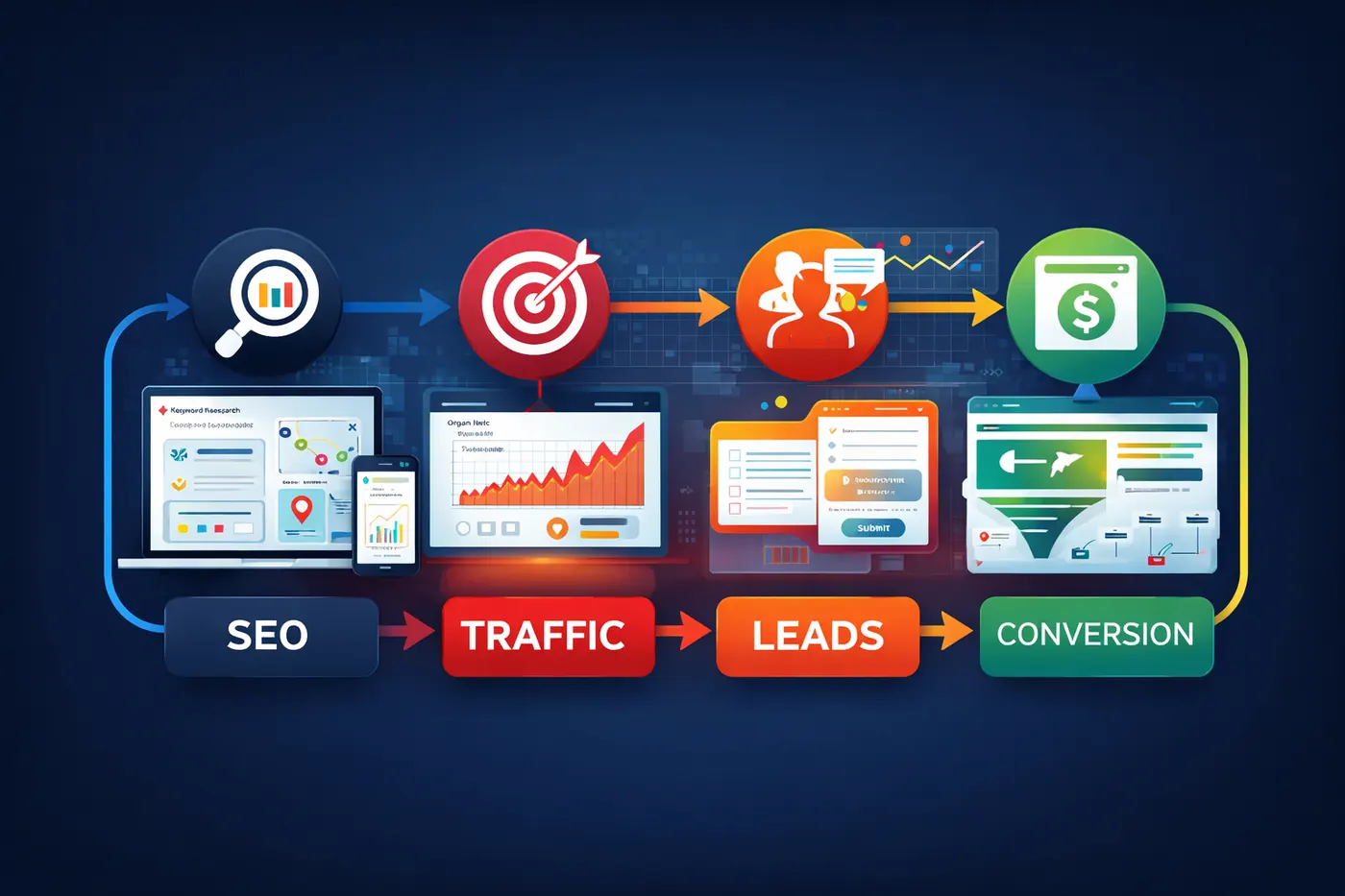
This is the framework every engagement we run is built on. The order is the point: each layer makes the one after it cheaper and more effective, which is why we build them in this sequence rather than all at once.
Technical Foundation
Everything else depends on this
If search engines and AI crawlers cannot reach, render and understand your site, no amount of content or authority will compensate. This layer is unglamorous, rarely produces an impressive report, and frequently unlocks everything that follows.
Content & Topical Authority
Gives search something worth ranking
Content mapped to buying intent rather than search volume, structured so it can be extracted and quoted as well as ranked. Depth across a topic matters more than volume across many, because topical authority is what makes an individual page credible.
Local & Entity Signals
Decides whether you can be verified
Search engines and AI models track your business as an entity, not a set of pages. When your details conflict across the web, a machine cannot tell which version is authoritative — and quietly favors a competitor whose data agrees with itself.
Authority & Corroboration
Third parties confirming what you claim
Anyone can call themselves the best in town on their own website. Independent sources saying it carries weight that self-description never will — with search engines, with AI systems, and with the human reading either.
Conversion & Measurement
Turns visibility into revenue
Rankings are not the product. Leads are. This layer exists because sending more traffic to a page that does not convert simply raises the cost of every future visitor — and because a campaign you cannot measure is a campaign you cannot improve.
A note on scope
The examples above are illustrative of the work each layer covers, not a fixed deliverable list. Every engagement is scoped individually around your market, your competition and your budget — and priorities shift as search itself changes. What stays constant is the sequence and the reasoning behind it.
We would rather tell you honestly what a layer involves than promise a number of blog posts that may not be what your business actually needs this quarter.
Why the order matters more than the list
Read the "FEEDS" line under each layer again. That is the entire argument for running this as a system.
Technical health makes content indexable. Content gives authority somewhere to point. Authority makes local signals more credible. Local and entity signals feed the corroboration AI assistants read when deciding whom to name. Conversion turns all of it into revenue that funds the next cycle.
Break the chain anywhere and the layers above it stop compounding. That is the mechanism behind traffic rising while leads stay flat — and it is why we will sometimes tell a prospective client that the honest first move is fixing something we do not bill for.
What's included — and what isn't
Almost nobody publishes the second column. We think that is exactly why it is worth publishing, because scope surprises in month three are the most common reason these relationships go wrong.
| Area | Included as standard | Not included by default |
|---|---|---|
| Technical | Ongoing crawl health, speed, structured data, indexation monitoring | Full site rebuilds, custom application development |
| Content | Written content, on-page work, service and location pages | Video production, photography, print collateral |
| Local | Google Business Profile, citations, review strategy, entity cleanup | Responding to reviews on your behalf without agreed guidelines |
| Authority | Earned links, partnerships, digital PR outreach | Paid link placements — we do not buy links |
| Conversion | Conversion path work, tracking setup, landing page optimization | Complete website redesign, ecommerce platform migration |
| Paid media | Not included | Google Ads and paid social are managed separately |
| Software | Our tooling, at our cost | Licences you hold directly — CRM, booking, chat platforms |
| Reporting | Monthly reporting on leads, calls and form submissions | Custom BI dashboards or data warehouse integration |
⚠️ The one item worth reading twice
We do not buy links. Paid link placements violate Google's guidelines, and the risk lands on your domain rather than on the agency that sold them. If a proposal includes a monthly quantity of guaranteed links at a fixed price, ask directly how they are acquired. The answer will tell you what you need to know.
Which layers matter most for you?
One question. It changes the answer more than most people expect.
Free · Nothing to fill in
Where should your budget go first?
Runs in your browser. No signup, no email, nothing stored or sent anywhere.
What monthly SEO services cost
Pricing in this industry is deliberately vague, so here is the market honestly.
Industry surveys through 2026 put the national average monthly SEO retainer at roughly $2,800. Single-location service businesses — contractors, dental practices, law firms — commonly sit between $800 and $1,500 per month in mid-competition markets. Competitive urban markets push that toward $2,000 to $3,000. Small businesses with regional reach typically range from $1,500 to $5,000.
Below roughly $300 to $400 a month, a full-service campaign is almost always templated and rarely moves anything competitive. That is not snobbery about budget — it is arithmetic about hours: a few hours cannot cover audit, content, outreach and reporting at once.
Which is why we also run build-your-own levels starting at $100 a month, in $100 increments. The distinction is scope rather than size. At that level you are funding one area done properly — the Google Business Profile managed consistently, or technical health kept clean, or a steady content cadence — instead of a whole campaign spread too thin to move anything. Add a level when you can.
✅ How we actually price
We build custom marketing packages around an affordable monthly budget rather than selling fixed tiers. Most of our local and regional engagements fall between $500 and $3,000 per month, and where a given business lands depends on competition, starting position, how many locations you need to reach, and how much production is in scope.
Tell us the budget you can sustain and we will tell you honestly what it can accomplish — including when the answer is that it is not yet enough to compete in the market you are asking about.
The full breakdown, including what drives a quote up or down and how project pricing compares, is on our Denver SEO pricing page.
Two layers below are frequently bought on their own rather than as part of a retainer: local SEO and Google Maps when the map pack is where your market actually decides, and AI search visibility when your customers have started asking an assistant instead of typing. Both are on the full list.
Retainer, project or hourly?
Match the model to the problem rather than to the invoice you would prefer.
| Model | Best for | Watch out for |
|---|---|---|
| Monthly retainer | Compounding work where ongoing capacity matters — which is most of SEO | Paying monthly without a stated scope or a baseline to measure against |
| Project | One-time diagnostic or implementation — an audit, a migration, a structured data build | Receiving a plan nobody then executes |
| Hourly | Narrow consultation, training, second opinions | Scope creep, and paying for thinking time rather than output |
A sensible sequence for a cautious buyer: start with a project audit, get the plan, then decide whether ongoing execution justifies a retainer. We offer the audit free precisely because it makes that decision easier — and because occasionally it tells us the honest answer is that you do not need us yet.
What the first 90 days look like
The most useful thing an agency can tell you before you sign is what month one actually produces. The honest answer is a baseline and a roadmap, not a traffic increase.
Weeks 1–3
Audit, baseline and roadmap
Technical audit, competitor and keyword landscape review, Google Business Profile assessment, and analytics and call tracking configured properly. A baseline is recorded before anything changes — without it, nothing that follows can be judged. The month ends with a prioritized roadmap.
Weeks 3–6
Technical repair and entity cleanup
Fix what is actively suppressing the site: crawl and indexation issues, speed, structured data, and conflicting business information across the web. This work rarely looks impressive in a report and frequently unlocks everything that follows.
Weeks 5–10
Content and local build
Publish content mapped to buying intent, build service and location pages with genuinely specific detail, optimize the Google Business Profile. Early ranking movement usually shows on lower-competition terms in this window.
Weeks 8–13
Authority and conversion
Earn links and third-party corroboration, then fix the conversion path so arriving traffic has somewhere to go. Conversion sits here deliberately — sending more traffic to a page that does not convert raises the cost of every future visit.
Month 4 onward
Compound and adjust
Rankings, leads and AI citations reviewed monthly against the week-one baseline. Priorities move as results come in. Meaningful organic results typically appear between months three and six, with substantial movement between six and twelve.
⚠️ On timelines
Anyone promising page one in thirty days is either misrepresenting the timeline or planning to rank you for your own business name and call it a result. SEO compounds, which means it is slow at the start and accelerates. That is a feature, and it is also why leaving is expensive once it is working.
Search and AI visibility run on one engine here
This is the part of the market that changed, and most retainers have not caught up.
People increasingly ask an assistant rather than run a search. Those assistants do not rank ten links — they assemble an answer and name a handful of businesses. Being named requires different things than ranking does: entity clarity, structured content, third-party corroboration, and facts specific enough to be quoted.
Here is what matters: those are the same foundations that make traditional SEO work. Which is why running them as two separate programs is a mistake — it leaves the overlap unowned and weakens both.
Ask any agency you are considering: do you run search and AI optimization as one engine, or two separate streams? The answer tells you whether they understand what changed.
In our system this is not a bolt-on. Layer 3 builds the entity signals AI models verify. Layer 2 structures content so it can be extracted and quoted, not just ranked. Layer 4 produces the third-party corroboration that machines weigh above anything you say about yourself.
And rather than asking you to take that on faith, we publish the actual methodology:
- A guide to entity signals — the five layers that make a business verifiable, with a free scorecard
- When the buyer isn't human — what AI agents evaluate when they shortlist vendors
- The 15-minute AI visibility self-audit — run it yourself, no tools required
If you want the standalone versions of this work, we run it as AI Overview optimization and generative engine optimization. Inside a monthly engagement, it is simply part of the system.
Where we work
We are Denver-based and know this metro market by market — competitive density, buyer profile and proximity change substantially between adjacent cities, which is why we build separate strategies rather than one metro-wide campaign.
Nine questions to ask any SEO agency
Including us. If a provider cannot answer these plainly, that is the answer.
- Do you run search and AI optimization as one engine or two separate streams?They share entity clarity, structured content and corroboration. Split across separate scopes, the overlap goes unowned. Ours: one engine — layers 2, 3 and 4 do both jobs.
- What baseline will you set in the first 30 days?Without a recorded starting point, month six is unfalsifiable. Ours: rankings, traffic, leads, calls and AI mention rate, recorded before anything changes.
- What exactly is not included?The most useful question on this list, and the one least often asked. Get it in writing before work starts.
- Who is actually doing the work?Ask to meet them rather than the person selling. Ask whether any of it is outsourced, and where.
- How do you acquire links?If the answer involves a guaranteed monthly quantity at a fixed price, they are buying them — and the risk lands on your domain, not theirs.
- How is success measured?Leads, calls and revenue. If the proposed measure is impressions, sessions or "keywords ranked," you will get a campaign optimized for graphs.
- What does month one produce?The honest answer is a baseline and a roadmap. Anyone promising traffic in month one is describing something other than SEO.
- What are the terms, and what happens if I leave?Ask who owns the content, the accounts and the data. The answer should be you, in every case.
- What would make you tell me not to hire you?A provider who has never turned work away is a provider who diagnoses every problem as the one they sell.
Red flags worth walking away from
- Guaranteed rankings. Nobody controls Google's results. Guarantees are either meaningless or describe ranking you for your own name.
- A small price attached to a big promise. A modest budget aimed at one specific deliverable is honest. A modest budget claiming to cover audit, content, links and reporting all at once is arithmetic that does not work — ask which of those is actually getting hours.
- Secret methods. Legitimate SEO is not proprietary. If they will not explain what they do, it is because explaining it would lose the sale.
- Reports without explanation. Graphs and no account of what work was performed is a warning, not a report.
- No baseline. If nobody records where you started, nobody can be held to where you end up.
- They cannot define AEO or GEO. In 2026 that is not a gap in vocabulary. It is a gap in the service.
Not sure SEO is even your problem?
Plenty of businesses have a pricing, capacity or follow-up constraint wearing a visibility costume — and buying traffic makes those worse rather than better. Our constraint diagnostic walks the six stages and names the one actually limiting you, and the free answer desk covers the rest without asking for anything first.
Monthly SEO services — common questions
The twelve we get asked most, answered the way we would answer them on the phone.
A credible monthly engagement covers five connected areas: technical health, content and topical authority, local and entity signals, authority building through earned links and corroboration, and conversion optimization with measurement.
What varies between providers is rarely the categories — it is the depth within them and whether the work is connected. Be wary of any proposal that cannot itemize its categories at all. "Ongoing optimization" with no further detail is a black box.
Most local and regional engagements run between $500 and $3,000 per month. Single-location service businesses commonly land between $800 and $1,500; competitive urban markets push toward $2,000–$3,000. Industry surveys in 2026 put the national average retainer near $2,800.
We build custom scopes around an affordable monthly budget rather than selling fixed packages, and build-your-own levels start at $100 a month in $100 increments if you want to begin with one area rather than a full engagement. Full detail on our pricing page.
A package is a list of separate deliverables priced together. A system is work sequenced so each layer makes the next one cheaper.
Technical health makes content indexable. Content gives authority something to point at. Authority makes local signals more credible. Local signals feed AI citation. Conversion turns all of it into revenue. Run as five separate line items those activities do not compound — which is exactly why traffic can rise while lead volume stays flat.
Month one produces a baseline and a roadmap, not a traffic increase. Technical fixes and Google Business Profile work often show movement within 30–60 days. Meaningful organic results typically appear between months three and six, with substantial movement between six and twelve.
AI citation lags furthest — usually four to eight weeks after the underlying signals change, because those systems re-crawl on their own schedule. Anyone promising page one in thirty days is misrepresenting the timeline.
Terms are set per engagement. Month-to-month is available and is what most clients run on.
Some engagements — particularly larger builds or those with significant upfront production — are structured with a defined term so both sides know what is committed. We will tell you which applies before you sign anything rather than after.
Paid advertising management, full website rebuilds, ongoing social media posting and third-party software licenses sit outside a standard monthly SEO engagement.
Some things overlap — a landing page built for conversion may fall inside scope while a complete site rebuild does not. The important part is that the boundary is stated in writing before work begins rather than discovered in month three.
Match the model to the problem. A project fits one-time diagnostic or implementation work — an audit, a migration, a structured data build. Hourly fits narrow consultation. A monthly retainer fits compounding work where ongoing capacity matters, which is most of SEO.
A sensible sequence for a cautious buyer: start with a project audit, get the plan, then decide whether ongoing execution justifies a retainer.
It should, and in most engagements it does not. The strongest 2026 programs run search and AI answer optimization as one engine, because they share the same foundations: entity clarity, structured content, third-party corroboration and topic strategy.
Splitting them across separate scopes leaves that overlap unowned and weakens both. Ask any prospective provider directly whether they run these as one engine or two separate streams.
Insist on three things. A baseline recorded in the first 30 days, so later numbers mean something. Monthly reporting on leads, calls and form submissions rather than impressions and sessions. And a plain statement of what was done, what is next, and what changed.
If a monthly report contains graphs but no account of the work performed, that is a warning rather than a report.
Sometimes, and occasionally it is the right call. If your site is technically broken, fixing that alone can produce meaningful gains. If your Google Business Profile is half complete, that alone can move local visibility.
What does not work well is buying content while technical problems suppress indexation, or buying traffic while the conversion path leaks. We will tell you when one layer is enough and when it is not.
Yes. We are based in Denver and know the metro deeply — from Cherry Creek to Thornton to Castle Rock — and we work with clients nationally across all fifty states.
Local market knowledge matters most where proximity and competitive density are decisive, which covers most local service businesses. For national or ecommerce work, geography matters far less than category understanding.
You should hear it from us before you notice it yourself. Because a baseline is set in the first 30 days, a stalled campaign shows up in the data rather than being a matter of opinion.
Sometimes the honest answer is that the constraint is not search visibility at all — it is pricing, capacity or follow-up — in which case continuing to buy traffic makes things worse rather than better. We would rather say that than keep invoicing.
Find out what's actually holding your site back
A free audit covering all five layers — technical health, content, local and entity signals, authority, and conversion. You get the findings whether or not you ever hire us.
Denver SEO since 2012 · A+ BBB Accredited · 5.0 from 60 Google Reviews
These systems run in every market we serve, starting with search in our own market, Denver. Owners in the trades should also read Advertising For Contractors, our dedicated contractor marketing site.
Where to go next
Two companions to this page: the plain-English small business SEO guide for owners who want to understand the work before buying it, and ecommerce SEO for stores, where the structure of the catalog decides most of the result.
Assets that accelerate the work on this page
Clients get put through properties we built: press release for business — a newswire that publishes releases with structured markup so AI systems can quote them — plus press release distribution through distributepressreleases.com and a business directory at usabusinesssearch.com. It is one reason the same budget goes further here. We don't need to knock anyone else's work; we'd rather show you ours. What you get, on a sliding scale →